Basmah Felemban
Murmur of Pebbles
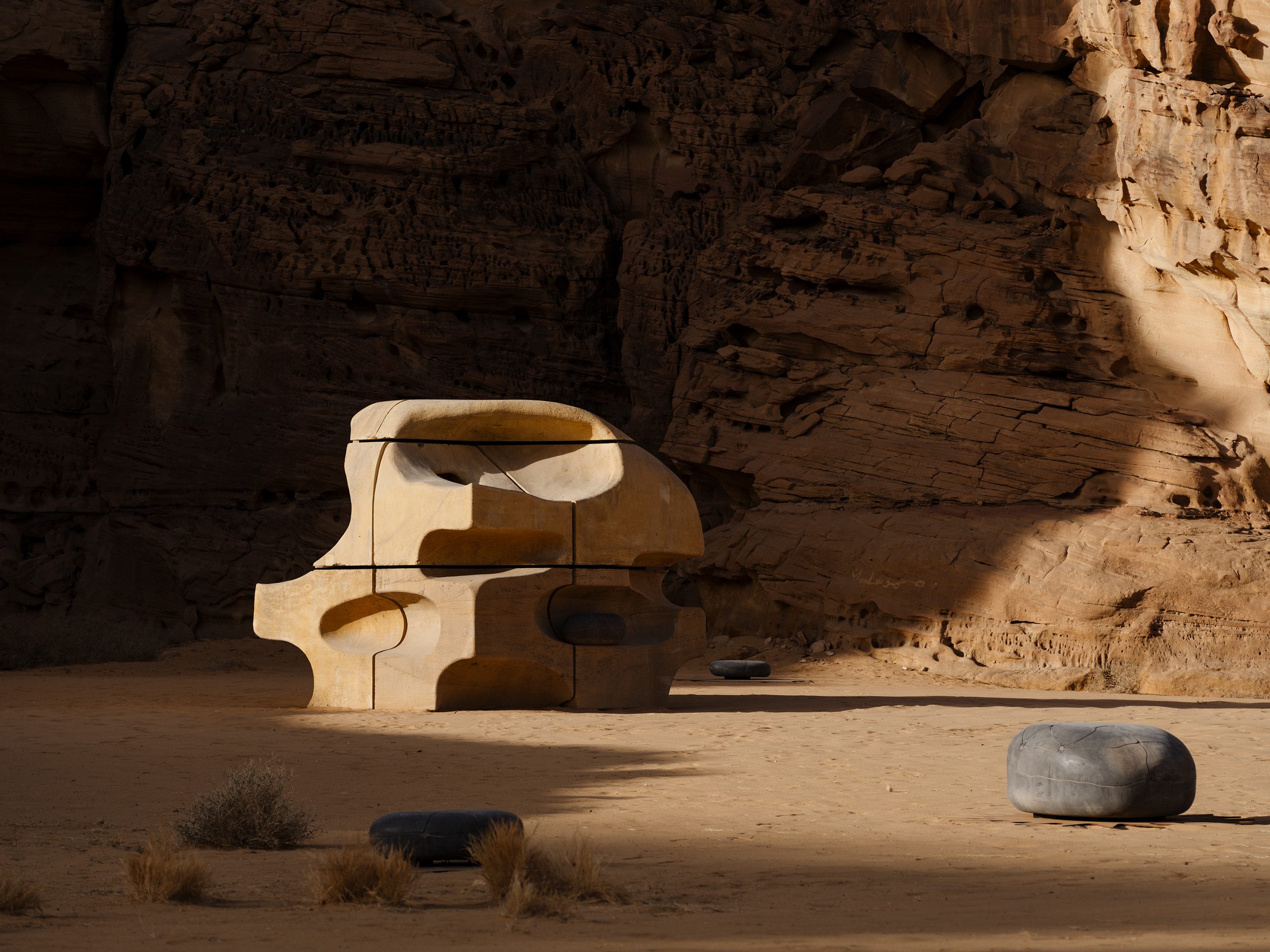
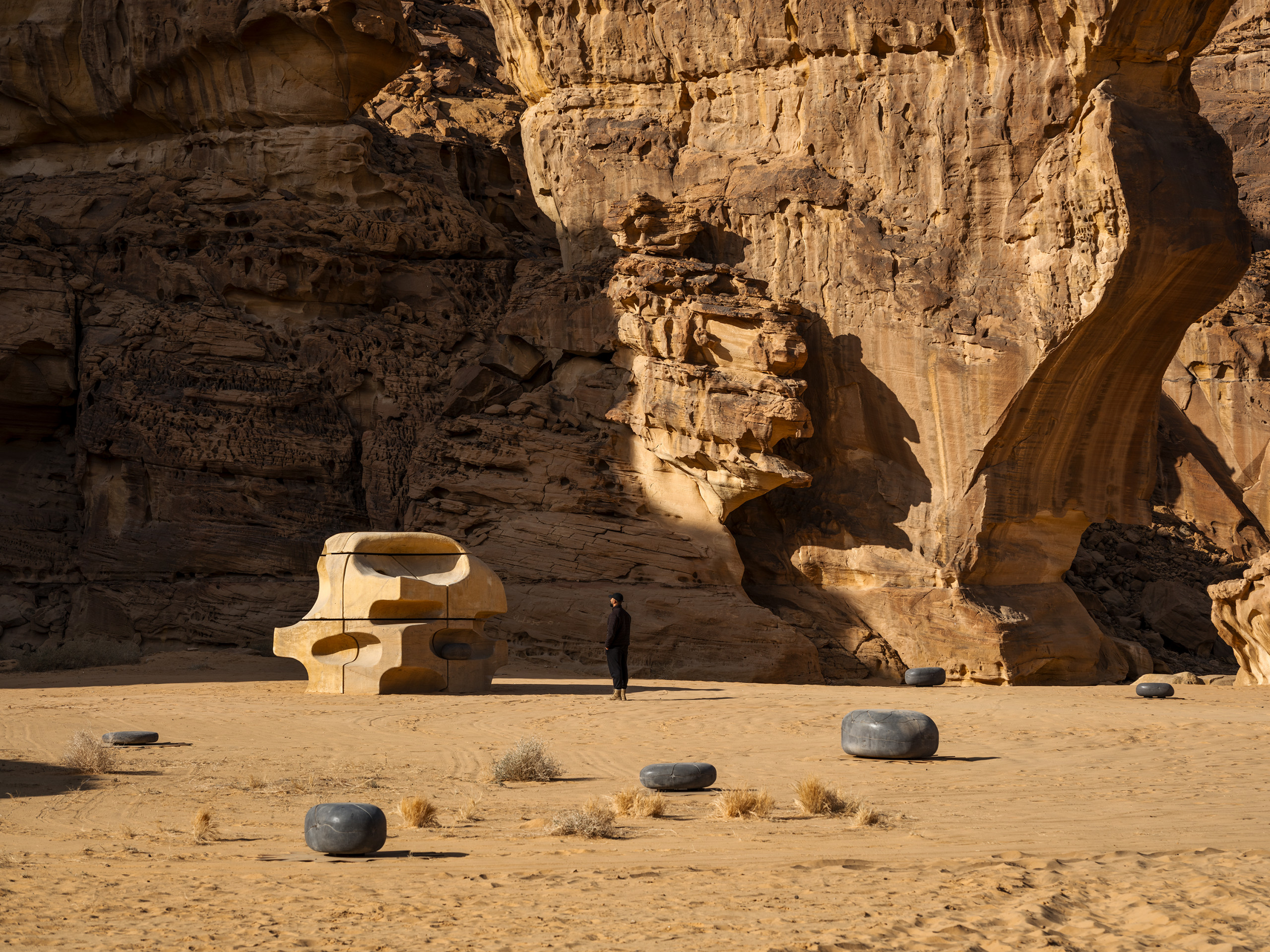
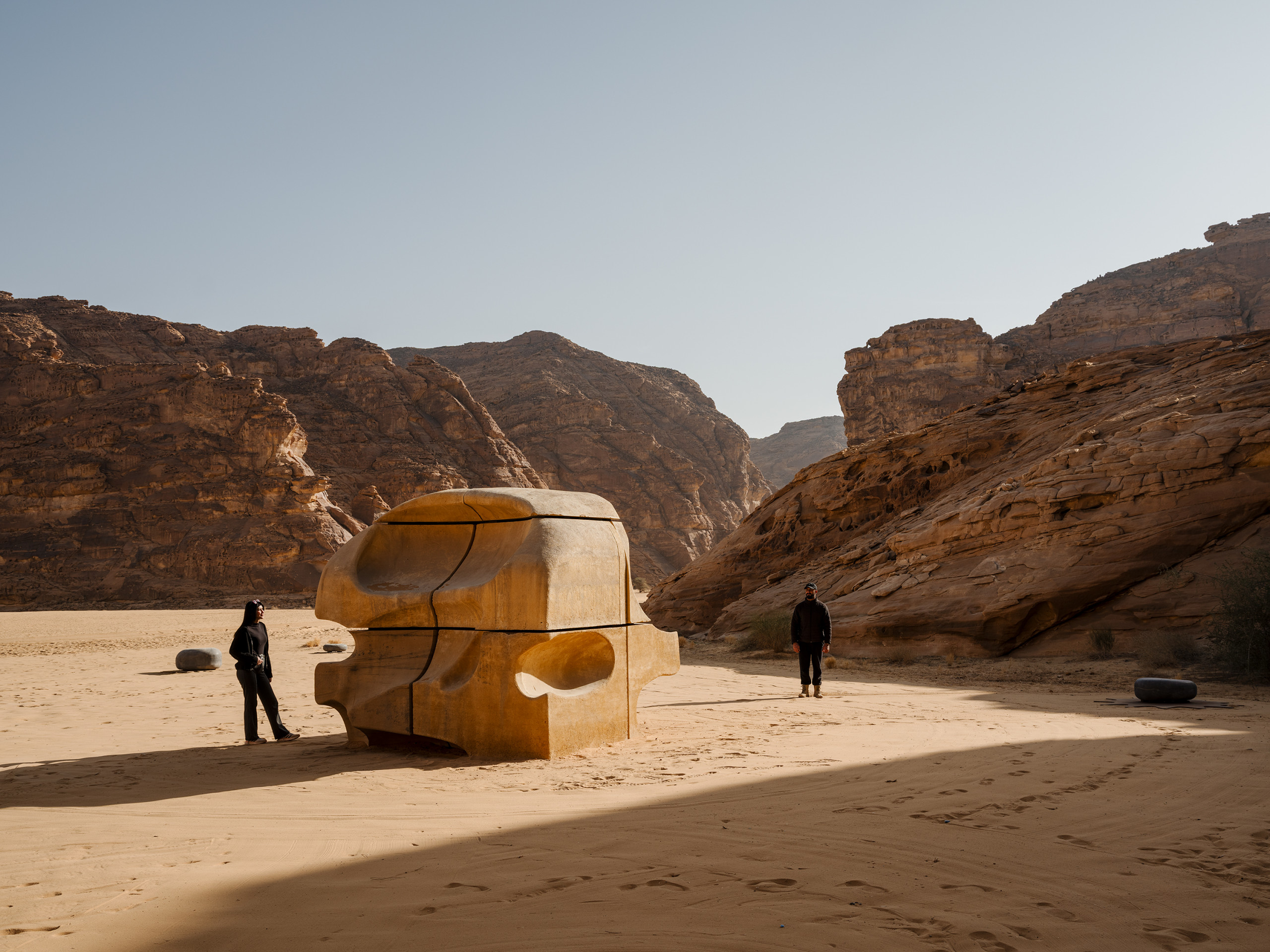
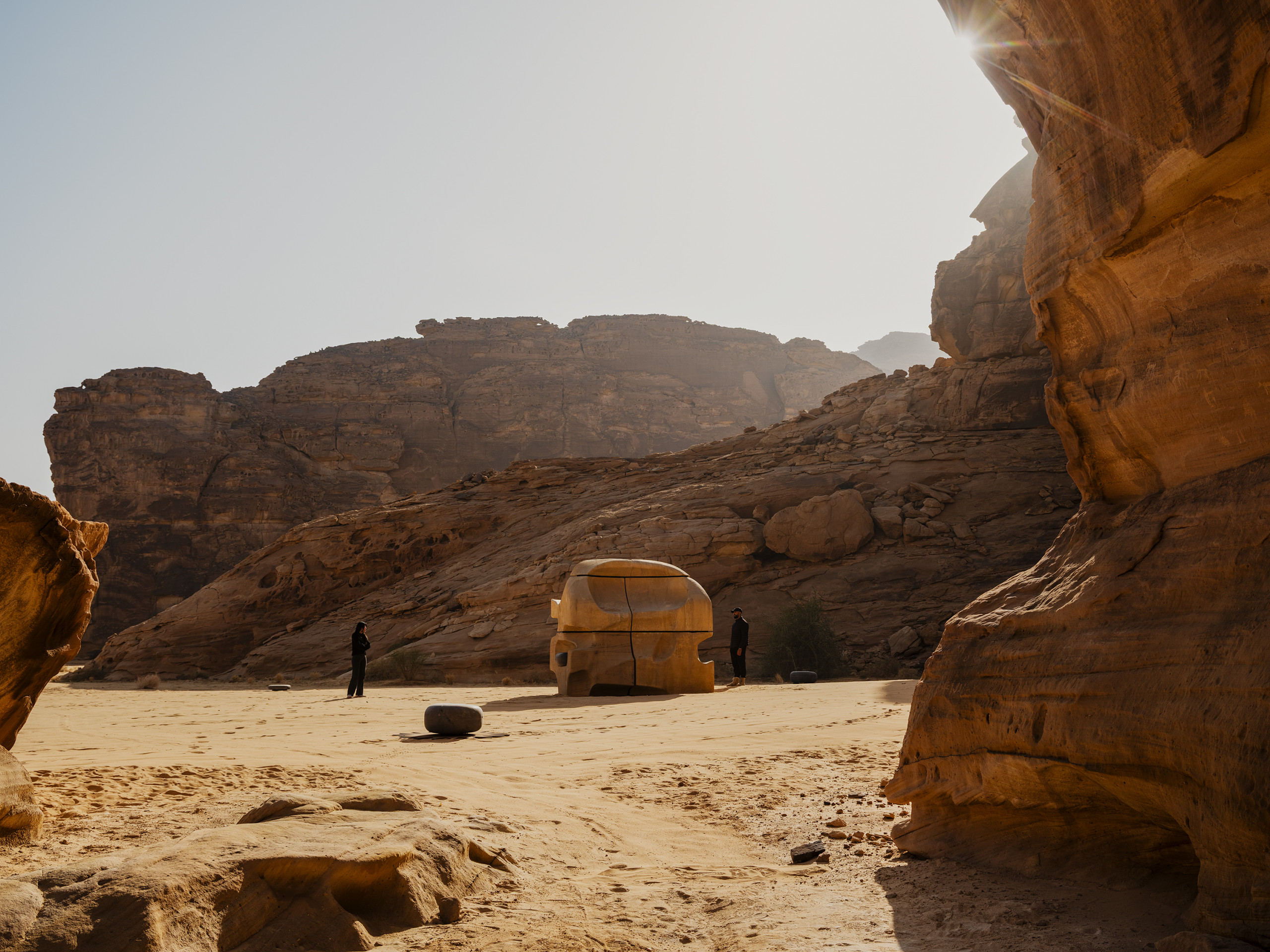
Originally commissioned for Desert X AlUla 2024, curated by Maya El Khalil and Marcello Dantas.
The valley and I had been calling for each other a long time before our first interaction. I came here surveying, much like the Jirry tribe of catfish I write about; wandering creatures that mine data from the land to guide their travels. Their elders teach that every pebble carries a memory of motion carved by floods, smoothed by collisions, and molded by the push and pull of time. From holding and rolling a single pebble in their hand, a Jirry can read the history of the valley’s waters and winds.
We see sediments as memory units. A pebble’s shape is a field report. The number and distribution of its equilibrium points reveal how repeatedly it was rolled or stablized. Flattened faces indicate prolonged contact with the ground or other stones, while elongated forms suggest directional transport. Subtle imbalances in curvature record cycles of collision, rest, and reactivation, allowing the pebble’s form itself to speak of motion, duration, and change.
Being a mythmaker means I’m inevitably an ecologist, so when I stood in the valley and held a pebble in my hand, I found a record of the history of its evolution. The sandstone mountains as riverbeds, pushed upward by tectonic force, with pebbles that once rolled along the bottom of flowing water becoming trapped inside vertical cliffs. Wind carving the sandstone until these thousands-of-years-old pebbles emerged again, falling and leaving cavities behind, slowly eroding into what are known as tafonis.
Both the pebble and this cavity are calculators of time. The Jirry and I leave this knowledge as an offering to the valley and its creatures, to navigate the land through feeling its sediments. We invite you to approach the valley slowly and with curiosity, as it speaks in fragments and murmurs, and the act of listening is a response to its call.
About the Artist
Born 1993, Jeddah, Saudi Arabia, Basmah Felemban is a multidisciplinary artist whose work navigates the intersections of Islamic art, geometry, digital design, and speculative world-building. Rooted in a background as a self-taught graphic designer, Felemban earned her MA in Islamic and Traditional Art from The King’s Foundation School of Traditional Arts in London, UK. She draws from Arab and Persian cosmographies, cartographic manuscripts, and philosophies from the 10th to 12th centuries, traditions that blur the lines between science, mythology, and imagination.
Her practice combines meticulous design methodologies with contemporary tools such as video games, CNC machines, and digital mapping, producing works that range from secret languages and puzzles to interactive interfaces, digital video art, and sculptures. Felemban’s research spans geology, genealogy, math, invasive species, and poetry as building blocks for world-building. This approach explores identity, migration, and the gaps in collective memory, particularly within her family history, shaped by oceans and service in pilgrimage.
Deeply influenced by her upbringing in Jeddah, its multicultural legacy and its proximity to water, Felemban resists the external framing of Islamic art through centering regional perspectives. Instead, her work embraces a forward-looking, speculative lens, grounded in the belief that imagination and futurism are essential for discovery and expansion.
Felemban’s exhibitions include Consecrated Networks (Athr Gallery), First House (Islamic Art Biennale), Worldbuilding (Julia Stoschek Collection), So it Appears (ICA at VCU), and Rhizoma (Venice Biennale). Felemban has established herself as a curator deeply committed to fostering the Saudi art community. She has led projects such as The Waves Won’t Stop When You Leave (2019), RSH Festival (2023), and the 9th edition of Young Saudi Artists, Biting Between One’s Teeth (2025).
Currently, Felemban explores video game development as an artistic practice, continuing to uncover the esoteric dimensions of the world, starting from the self and radiating outward. Her work is anchored in the belief that art is a vital existential tool for expanding human understanding.